Shunting operations
Saving fuel is a priority during shunting operations. The diesel-electric drive train and additional functions such as the Eco Drive (VED), Eco Mode switch, Start-Stop function, the Stage IIIB/2 mode and much more are available for this purpose.
With the driver assistance and information system you have all the information on fuel consumption available at all times:
- Fuel consumption per hour of operation (current value)
- Fuel consumption per kilometer (current value)
- Daily fuel consumption
- Limit indicator to prevent over-filling
- Overall fuel consumption
- Current output
- Current meter measuring daily use
Efficient engine management
The engine management can also be structured more efficiently in conjunction with the ECO mode by limiting the output of the diesel engine to 1,500 kilowatt (this is set using the HMI on the driver’s console). This engine setting also helps to reduce maintenance costs. The reduced output allows a longer period to elapse before the engine is reconditioned, which is yet another advantage when maximum output is not required during shunting operations.
Experience has shown that almost 80 percent of a locomotive’s service life is spent waiting, during which time the diesel engine simply idles. The Start-Stop function switches the engine off during these phases, and other important advantages include noise reduction and the engine’s longer life span thanks to low-maintenance operation with minimal wear and tear.
If you opt for the DE 18 Smart Hybrid locomotive, the diesel engine’s stop phases can be extended still further because all the auxiliary systems run off the traction battery. The Plug-In Hybrid radically reduces the time the locomotive spends idling.
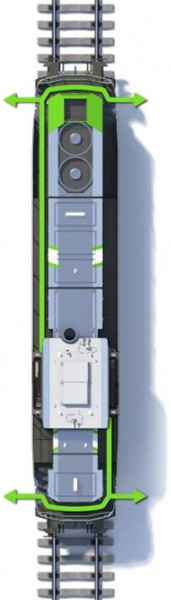
See clearly what’s going on at all times: The mid-cab concept is still the best solution for shunting work. It impresses with its good 360 degree view, and allows the driver to change consoles and directions very quickly. Safe access ways designed as riding platforms cater to frequent alighting and climbing on board. Spacious walkways across the top of the buffers are accessible from the track via the access ways, and they enable personnel to safely remain inside the locomotive’s loading gauge while changing from one side of the locomotive or track to the other. If the driver does need to get down from the locomotive, e.g. when approaching a damaged train, he does so via a very well lit access platform.
With the inclusion of an automatic shunting coupler and the installation of radio remote control, the DE 18 has all the characteristics of a modern shunting locomotive. When operating the radio remote control, the locomotive driver does not have to leave the locomotive when moving from the cab to the riding platform at the end of the vehicle. This protects him from the train traffic on the adjacent track and from dangerous areas and obstacles next to the track. With an installed diesel engine output of 1,800 kilowatt, shunting with high trailing loads is no problem, and the underside of the DE 18 is designed so that the vehicle can negotiate classification humps and shunting facilities unhindered.
Comfort during longer main-line operations
A driver’s cab that provides everything an ultramodern working environment requires is worth its weight in gold – especially on longer runs.
The comfortable furnishings on the DE 18 – the sophisticated lighting concept, the ergonomic, clearly arranged configuration of the operator’s controls and display instrumentation, the air-conditioning – are all set up to meet the needs of the personnel. Speeds of up to 120 kilometres per hour go without saying; as does multiple unit operation.
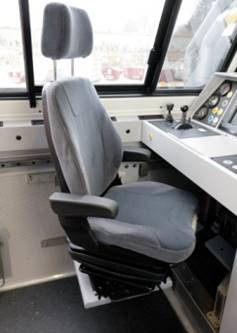
Well laid out driver’s console
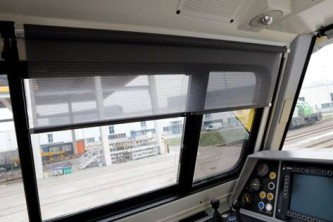
All the operator’s controls and display instruments are arranged clearly and ergonomically. The locomotive driver has an excellent 360 degree view through the front and side sliding windows, and he can see along the locomotive all the way to the buffers. Two windows in the cab door let in even more daylight, and easily adjustable sunblinds on the front and side windows protect against unwanted glare.